
The Art of Noticing: What Birds, Horses and a Purpose-Led Team Taught Me About Sustainable Leadership
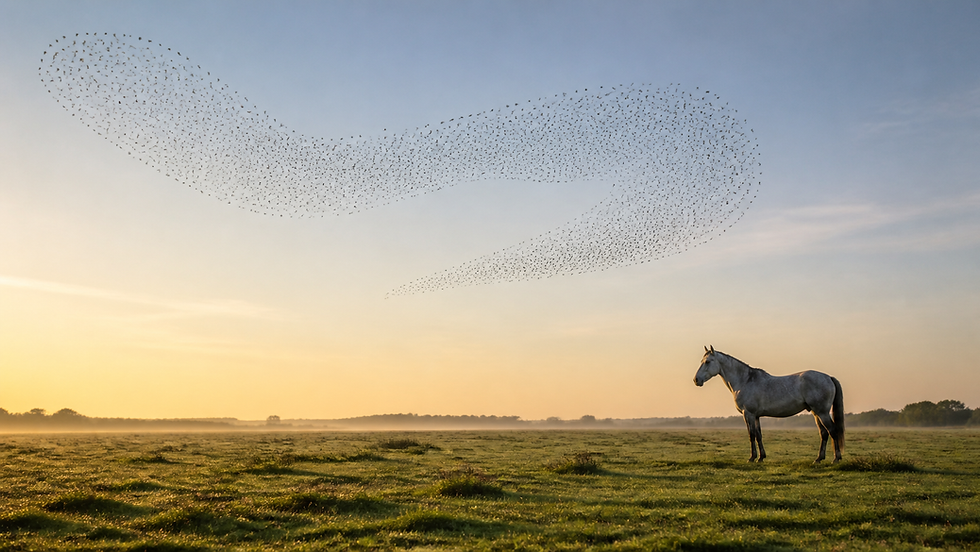
There is something quietly mesmerising about watching a murmuration of birds.
Thousands of birds move together at speed, changing direction almost instantaneously, yet somehow they never seem to collide. As I stood watching them recently, I found myself becoming less interested in the spectacle and more curious about what was happening within it. How was it possible for so many individuals to move with such pace and agility without descending into confusion, conflict or chaos?
The more I watched, the more it struck me that nature may have found a way of solving a challenge that organisations are still wrestling with today.
The birds were not successful because they flew harder than every other species. Nor were they successful because one bird was directing the whole flock. Their strength lay in something much more subtle: they were constantly noticing one another and making tiny adjustments that kept the whole flock connected, moving in the same direction and adapting before problems became collisions.
It left me wondering whether sustainable leadership works in much the same way.
Perhaps high-performing teams stay healthy because they become better at noticing what is changing around them, and making small adjustments before those changes become much bigger problems.
That thought stayed with me as I prepared for a recent Let’s Talk session, Who Supports the Supporters? It also helped me connect three experiences that, on the surface, appear completely unrelated: watching a murmuration of birds, working alongside a remarkable charity team, and spending time with horses.
Each one taught me something different about leadership. Together, they taught me about what I now think of as the art of noticing.
The first teacher: the birds
When we think about high-performing teams, we often admire the outcome. We see the results, the collaboration and the ability to navigate change. We rarely stop to consider what makes that possible.
Watching the birds reminded me that healthy systems do not rely on dramatic interventions. They rely on countless small acts of awareness.
Each bird pays attention to those around it. Each bird makes small adjustments. Each bird contributes to the success of the whole flock. No single bird is trying to carry everyone else.
That feels like an important lesson for organisations because, too often, we wait until something has gone badly wrong before we intervene. We wait until relationships become fractured before we have difficult conversations. We wait until someone is overwhelmed before we ask how they are. We wait until exhaustion becomes burnout before we begin talking about wellbeing.
Nature does not seem to work like that. Nature notices and adjusts earlier. Because it adjusts earlier, it rarely needs dramatic correction later.
The more I reflected on this, the more I found myself wondering whether one of the most important leadership capabilities for the future is not resilience at all. Perhaps it is the art of noticing.
The second teacher: a charity team
I have also had the privilege of working with a charity whose people spend every day supporting others through some of the most challenging moments of their lives.
Like so many purpose-driven organisations, they cared deeply about the people they served, and their commitment was clear. What became apparent, however, was that many of the people whose role was to support everyone else had quietly become the people nobody was really noticing.
As we listened to their experiences, familiar themes began to emerge. People spoke about carrying enormous responsibility, constantly responding to new demands, putting colleagues first and leaving very little space simply to stop and think. They described reactive ways of working, emotional load that was not always recognised and an increasing sense that everyone was trying to hold everything together for everyone else.
What struck me most was that none of this was visible on the surface. Everyone appeared professional, committed, capable and dedicated. If you had walked into the organisation for a day, you might never have known that people were carrying such a significant emotional and cognitive load.
It reminded me that the greatest burden is not always the work itself. Sometimes, it is the effort required to hide how hard the work feels.
Many of us have become incredibly skilled at presenting ourselves as calm, positive and in control, even when our internal experience feels very different. We tell ourselves that this is professionalism, yet maintaining that gap requires enormous energy. Every day, we invest emotional effort in holding together two realities: the one we are experiencing internally and the one we believe everyone else expects to see.
Over time, that comes at a cost, emotionally and cognitively. When so much of our energy is spent maintaining that gap, there is inevitably less energy available for creativity, thoughtful decision-making, collaboration and connection with the people around us.
It made me wonder whether burnout is often less about individuals failing to cope, and more about organisations failing to notice what has been happening for quite some time.
The third teacher: the horses
I have been lucky enough in my career to work with professionals and horses together. In one team coaching session, we moved from a boardroom to a field and invited horses into the session.
Whenever I mention this, people often assume that the horses are there to teach leadership. I do not think they are; they simply reveal what is already there.
One participant approached a horse looking completely calm. They walked confidently, smiled as they approached and looked every bit the composed leader. Yet, almost immediately, the horse stepped quietly away. No words had been uttered, no instructions had been given, and there was no judgement.
As we reflected together afterwards, the participant recognised that, although they had looked calm externally, internally they had been feeling anxious and uncertain. The horse was not responding to their words or their professional persona. It was responding to something much more authentic: the incongruence between their inner experience and their outward presentation.
That moment, and many similar moments, have stayed with me. Although people are not horses, we often notice similar things. We have an instinct for when something feels off-kilter.
Words can get in the way of us noticing what we instinctively sense. We notice when someone who is usually engaged becomes quieter. We sense when somebody walks into a room carrying tension, even if they never mention it. We feel when conversations become guarded or when a team begins to lose its energy.
The question is not whether we notice. The question is whether we act on what we notice.
Too often, we sense that something is not quite right but tell ourselves that now is not the right time to ask. So we leave it, and by the time we eventually have the conversation, the problem has become far bigger than it ever needed to be.
The art of noticing
Those three experiences gradually came together for me.
The birds taught me about collective awareness. The charity team reminded me of the hidden emotional load carried by people who spend their lives supporting others. The horses demonstrated the importance of emotional congruence and how much energy it takes to keep our inner and outer worlds apart.
Together, they reinforced something that sits at the heart of our CARE approach to therapeutic coaching and team development.
Healthy teams do not simply become more resilient by accident. I believe they thrive when they become better at noticing.
They notice themselves. They notice one another. They notice the system they are working within.
Most importantly, they notice early enough to make small adjustments before those adjustments become major interventions.
Turning noticing into practice
One of the questions I am often asked is: “What can leaders actually do?”
The encouraging answer is that it does not usually require large wellbeing programmes or complex interventions. More often, it begins with changing the quality of everyday conversations.
Start meetings with a check-in
At the beginning of a meeting, rather than moving straight into the agenda, we might ask: “How is everyone arriving today?” or “Is there anything on your mind that might affect today?”
A one-word answer is enough. The purpose is not to solve everyone’s problems; it is simply to acknowledge that people arrive with different emotional loads.
Create alignment when pressure increases
When pressure begins to increase, we can create alignment by asking three simple questions:
What matters most?
What can wait?
Who needs to know?
Clarity reduces cognitive overload and helps teams focus their energy where it matters most.
Pause before reacting
When emotions begin to rise, we can create a pause before reacting by noticing what is happening in ourselves. Naming the feeling, normalising it and asking, “What would be most helpful now?” can change the quality of a conversation before it escalates.
Make reflection part of the work
Perhaps most importantly, we can make reflection part of the work rather than something we promise ourselves we will do when things become quieter.
Five minutes spent asking, “What has given us energy this week? What has depleted us? What should we carry forward? What should we leave behind?” can become one of the most preventative conversations a team has.
These are not complicated techniques. They are simply ways of helping people notice earlier.
Leadership as the practice of noticing
As I think back to those three teachers, I am increasingly convinced that they were all pointing towards the same lesson.
The birds taught me that healthy systems depend on countless small adjustments made together.
The charity team reminded me that the people who care most are often the people we notice least.
The horses demonstrated that pretending we are fine requires far more energy than we often realise, and that authenticity creates space for better connection, better thinking and healthier relationships.
Perhaps this is where leadership is heading. It is not about having all the answers; it is about awareness and the art of noticing.
Noticing our own emotions and being aware of their impact on others. Noticing the systems we are creating every day through our conversations, our behaviours and the cultures we shape.
Strong teams are the teams that notice sooner, have the conversation while the issue is still small, and make the tiny adjustments that allow everyone to keep moving forward together.
The birds do not wait until they are about to collide before changing direction. Neither should we. Perhaps the real art of leadership is not preventing every challenge, but learning to notice early enough that people never have to face those challenges alone.

Written by Bonnie Clarke
Bonnie is the CEO of Taylor Clarke. She is driven by making a positive impact on places of work, for the people who work there. She is values led and is committed to working with purpose and compassion to unlock potential in individuals and teams. She is passionate about the psychology of human communication.


