Are We Building Organisations That Future Generations Will Thank Us For?
Written by Bonnie Clarke, Taylor Clarke CEO
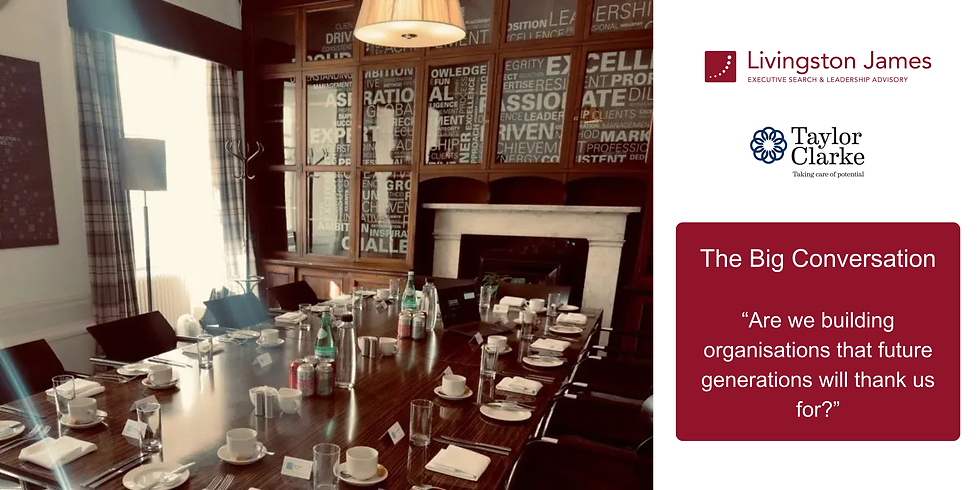
Over the years, Jamie Livingston and I have shared many conversations about purpose, leadership, and the kind of organisations we want to build. Our paths have crossed often, through work, shared values, and a common belief that business can and should be a force for good. For some time, we’d spoken about doing something together that reflected that belief, something that went beyond transactional networking and created the kind of dialogue leaders are craving today: honest, human, and future focused.
That idea became The Big Conversation.
A Different Kind of Space
We’ve both noticed how the landscape has shifted over the past five years. Networking has become less natural, infrequent, transactional, and often surface-level. At the same time, the issues leaders face have become deeper and more complex, what we might call existential. As CEOs and Chief People Officers, we’re expected to have answers to questions no one has faced before: AI, hybrid working, generational divides, and the ethics of leadership in an uncertain world. Yet, there are so few spaces where we can explore those questions openly.
So, together, Taylor Clarke and Livingston James decided to create one.
We invited a small group of senior leaders to join us for a breakfast conversation on a single, powerful question:
Are we building organisations that future generations will thank us for?
It’s a daunting question, one that can feel too big to start with, so we began with something more tangible:
What leadership attributes are required now to ensure future generations look back with gratitude to the leaders of today?
Reflections and Realisations
The conversation began with Jamie introducing the Māori concept of whakapapa the idea that we are part of an unbroken chain of past, present, and future generations. It asks us to lead with both gratitude and responsibility: to honour what has come before, while being conscious of the legacy we’re creating.
From there, the discussion flowed naturally, thoughtful, honestly and deeply human.
Leaders spoke about the tension between human capability and technological acceleration, how to ensure that people and technology work hand in glove, not in competition. There was a recognition of the fear some colleagues feel about the pace of change, particularly older generations, and a shared sense of duty to support them with compassion rather than burden them with anxiety.
We asked: How do we carve out time to think long-term when business-as-usual tethers us to the now? That question seemed to resonate across the room.
AI featured early in the discussion, but the focus wasn’t on jumping in blindly. Instead, the group aligned on a commercially grounded approach: adopting AI where it clearly improves outcomes, while being deliberate about risk, governance, and ethics.
Curiosity as an Antidote
One of the most powerful ideas to emerge was the need for space, space for discussion, curiosity, and learning. In a world that often rewards binary thinking, leaders must be able to hold multiple perspectives at once: to listen deeply, synthesise wisely, and still make courageous, clear decisions.

The group explored practices like reverse mentoring as a way of cultivating curiosity and humility, and of bridging generational gaps. We also reflected on how hybrid working has challenged our sense of connection, how some people now feel hesitant, even fearful, about returning to the office, and how leaders can create an invitation rather than an instruction to come back together. We talked about nurturing joy in working in teams, not on Teams. ‘The office being the new offsite ’notion emphasised that it’s not about just being in the same building but using that opportunity to have conversations that wouldn’t be happening otherwise that is key.
Relearning the Basics of Leadership
A theme that surfaced repeatedly was the importance of re-building foundational management skills. The pandemic disrupted not only where we work, but how we learn to lead. Many emerging managers have missed out on informal learning and real-time decision-making, and as a result, there’s a risk of creating fewer bold confident leaders. Part of our responsibility, we agreed, is to rebuild those capabilities, to help managers feel confident again in having adult, honest conversations and to re-establish a culture of shared accountability. The myth of leaders needing to know the answer to every question is more prevalent with ‘accidental managers’ or technical specialists promoted into managerial roles. Support at this level is key to help them navigate this misnomer of confident leadership not meaning ‘leader who knows everything’
Leading with Courage, Compassion and Conviction
As the conversation drew to a close, the energy in the room was one of connection and possibility. We circled back to our original question and asked:
How can leaders use their influence to shape a fairer, more conscious society? Are we leading from courage, compassion, and conviction, or from fear, ego, and habit?
It was an extraordinary morning, rich in thought, grounded in shared values, and filled with the kind of dialogue that reminds us why we do what we do.
What Comes Next
The Big Conversation will continue. This first event was a powerful reminder that leaders crave real connection and space to think. At Taylor Clarke and Livingston James, we’re committed to holding that space, for curiosity, reflection, and challenge, and to continuing to ask the big questions that shape how we lead.
Because the way we lead today will be the legacy we leave for tomorrow